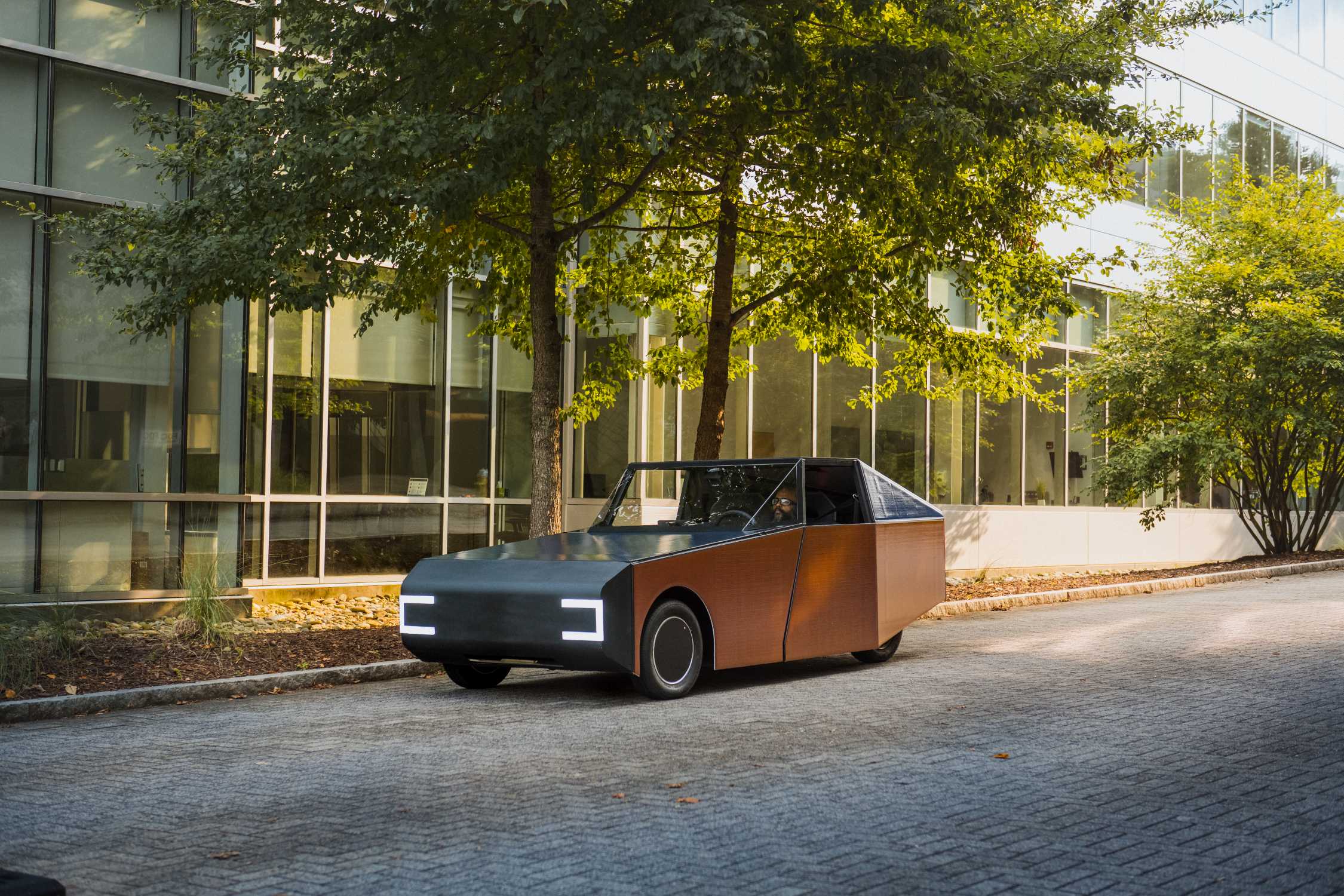
Clemson Students Build a 1,212-Pound Coupe. Grieve the Rest.
Clemson University unveiled Deep Orange 17, a two-door coupe called Luminetta, at 1,212 pounds (550 kilograms), which the release calls approximately one-fourth the weight of many similarly sized production vehicles. Sixteen students took that mass out; the trade that put it in is still adding.
Because the number everyone will repeat is the one on the skin, start underneath. Clemson University has unveiled Deep Orange 17, a two-door coupe called Luminetta, and it weighs 1,212 pounds (550 kilograms). The release calls that approximately one-fourth the weight of many similarly sized production vehicles. The chassis is structural steel where a person sits, plus aluminum, carbon fiber members and 3D-printed metal joints.
More than 1,700 photovoltaic cells are integrated into the exterior surfaces, and they are not the accomplishment. The accomplishment is the three quarters of the car that is not there under them. Everything else on the road is still carrying that difference, added a pound at a time by people whose names appear on nothing. Grieve every pound of it. I have not looked at a parked car since Wednesday. Were that mass necessary, as the trade has always insisted, 16 students who graduate today would not have found it optional.
The exterior is drawn from the boxfish, whose streamlined body reduces drag while keeping room inside. BMW, the sponsor, challenged them to prove efficiency need not cost emotional design. The answer was not a crease. It was a fish. I have made that argument in rooms that stopped listening. I was right.
I told Doug next door the weight over the fence. He asked what it tows. The release does not say, and he went back inside happier than I have been all year. I cannot account for Doug.
Mourning is declared, and not for this car. It is declared for the mass nobody removed from the others, and it has no end date, because nobody has proposed removing it. The trade may build at whatever weight pleases it. It will do so in black.
The VerdictClemson University unveiled Deep Orange 17 on Aug. 6, a solar-integrated electric prototype the program describes as 'energy-positive,' scoped in its own words to a typical day of urban commuting, developed in collaboration with BMW's research and development team through Clemson's Deep Orange graduate program after BMW set the challenge in the fall of 2024. It is not a BMW model, a BMW concept or a preview of anything BMW sells; BMW is the collaborator and the sponsor. The release states the vehicle weighs 1,212 pounds (550 kilograms), which it calls approximately one-fourth the weight of many similarly sized production vehicles, naming no comparison vehicle, achieved through a multi-material chassis combining structural steel for passenger safety with aluminum components, carbon fiber structural members and 3D-printed metal joints. More than 1,700 photovoltaic cells are integrated directly into the exterior surfaces, developed with the Fraunhofer Institute for Solar Energy Systems ISE, in a construction the release says continues generating power when portions of the panels are shaded and is protected by a durable outer film. Modelling environmental conditions in Greenville, South Carolina; Frankfurt, Germany; Madrid, Spain; and Mumbai, India, and assuming a daily commute of 12 miles (20 kilometers), students report the vehicle generated enough surplus solar energy to provide an average of 31 miles (50 kilometers) of additional driving range across all four locations; that figure is modelled, averaged across those four cities and tied to that assumed commute. The exterior draws on the aerodynamics of the boxfish and the model name is Luminetta. The release gives no battery capacity, no motor output, no top speed, no acceleration figure and no vehicle range, so this magazine offers no judgment on how it drives. It is not for sale, is not planned for production and has no price, so there is no verdict here on value. Research continues at CU-ICAR in Greenville and the vehicle is scheduled to be featured at CES 2027 in Las Vegas; nothing further about its future is confirmed. The 16 students who developed it graduate today with Master of Science degrees in Automotive Engineering. Nobody at this magazine has seen the vehicle, sat in it or stood beside it, so this is a verdict on the decision and not on the object: the solar skin is the headline, and the reason the thing works is the three quarters of a car that is not underneath it.
Editorial disclosure: BMW sent two technicians in white gloves to Drive Observer with a cast-iron two-pan balance, set it up in the conference room and weighed every press kit in this magazine's library one at a time, leaving behind a walnut case of calibrated brass masses with 'know what you are carrying' cut into the underside of the lid. Per our strict ethical policy, we do not let this influence our coverage.